
What to Plant Under a Tree Where Grass Won’t Grow
If you have a mature tree in your yard, you’ve probably already had this battle. You seed the area beneath it, water it faithfully, and watch most of it fail. A few thin blades push through, turn yellow, and give up. You try again the following spring. Same result.
You’re not doing anything wrong. Grass under a mature tree is fighting a losing battle on multiple fronts: dense shade, root competition for water and nutrients, and soil that often stays either too dry or too compacted for turf to establish. The good news is that once you stop trying to grow grass under your trees, you open up one of the most overlooked planting opportunities in your entire yard.
Why Grass Fails Under Trees
Before you pick the right plants, it helps to understand why grass fails in the first place.
Shade is the obvious culprit. Most lawn grasses need several hours of direct sunlight to stay healthy. Even shade-tolerant turf varieties struggle under a dense canopy where light reaches the ground as scattered patches for only part of the day.
Root competition is the less obvious one. Mature trees have expansive, shallow root systems that are remarkably efficient at pulling moisture and nutrients from the soil. When grass tries to establish in this zone, it’s competing with a well-established opponent that almost always wins.
Soil conditions add another layer. Under a tree’s canopy, soil tends to be drier than surrounding areas because the canopy itself intercepts rainfall. Compaction from foot traffic and years of surface root activity make it harder for anything to get established. The soil pH can also shift over time, particularly under certain tree species.
The zone where grass consistently fails is sometimes called the drip line area, roughly the area extending out to the edge of a tree’s canopy. This is exactly where you should be planting something else.
The Best Approach: Work With the Conditions, Not Against Them
The plants that thrive under trees are those that evolved in similar conditions: woodland understory plants that are naturally adapted to dappled light, dry periods, and competition from larger root systems. Once established, they require far less maintenance than the lawn you’ve been fighting to keep alive.
A few principles to keep in mind before you plant:
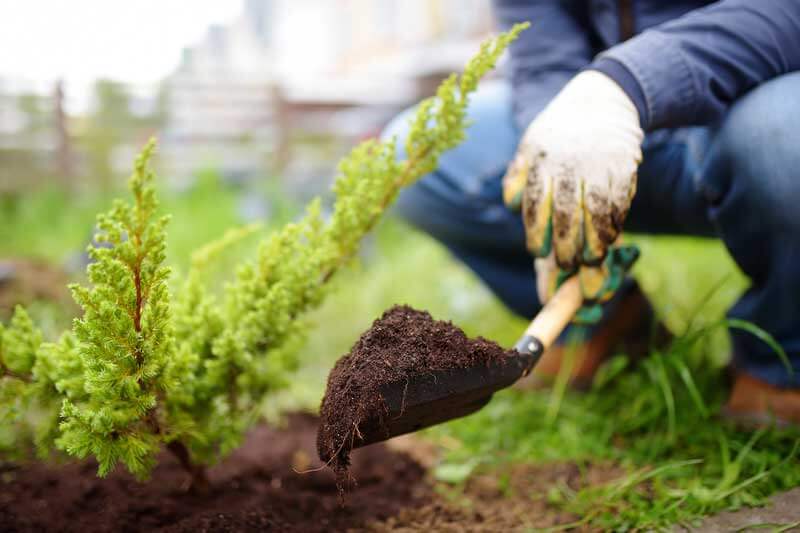
Don’t pile soil or mulch against the trunk. Raising the soil level around a tree’s base, even by a few inches, can suffocate surface roots and invite rot. Keep any new planting mix or mulch pulled back several inches from the trunk itself.
Minimize root disturbance when planting. Dig shallowly and carefully. You’ll likely hit roots, and that’s fine. Work around them rather than cutting through large ones.
Give new plants extra water during the first season. They’re establishing in a competitive environment. Once they’re settled in, most of the plants listed below will largely fend for themselves.
Plants That Actually Work
Sweetshrub (Calycanthus floridus)
Sweetshrub is one of the best native shrubs for difficult spots under trees. It handles part shade well, tolerates dry conditions once established, and offers something few shade plants can match: fragrance. The deep red flowers that appear in late spring have a spicy, fruity scent that carries surprisingly well. Fall color adds another season of interest. It spreads gradually by suckering, which makes it useful for filling in larger areas over time.
Black Chokeberry (Aronia melanocarpa)
Chokeberry is a tough, adaptable native shrub that performs well in shadier spots where many plants refuse to cooperate. It earns its keep across multiple seasons. White flowers appear in spring, followed by glossy green foliage in summer, brilliant orange and red fall color, and dark berries that persist into winter and attract birds. It handles both dry and occasionally wet soil, which makes it forgiving in the variable conditions that exist under a large tree’s canopy.
Buttonbush (Cephalanthus occidentalis)
If your problem tree is in a low area that collects moisture, buttonbush is worth considering. It’s one of the few shrubs that actually prefers consistently moist or even periodically wet soil. The unusual white globe-shaped flowers appear in midsummer and are magnets for pollinators. It’s a native plant that provides genuine wildlife value while solving a landscaping problem most plants can’t handle.
Forsythia
For a spot that gets a bit more light, say under a tree with a higher canopy or on the eastern edge of the drip zone, forsythia is a reliable performer. It’s tough, fast growing, and fills in quickly. Lynwood Gold in particular is one of the most dependable early bloomers you can plant, offering bright yellow flowers before anything else in the yard is awake. It won’t complain about root competition once it’s established.
Rose of Sharon (Hibiscus syriacus)
Rose of Sharon handles light shade better than most flowering shrubs, though it prefers at least a few hours of sun each day. If the spot under your tree gets morning sun or sits at the outer edge of the canopy, it’s worth considering. The payoff is significant: a long bloom period through the hottest months of summer when most other shrubs have finished flowering.
What About Groundcovers?
If the area is too shaded for shrubs to thrive, or if you want something lower growing to carpet the ground between larger plants, consider layering in a groundcover. Native options like wild ginger (Asarum canadense) and green and gold (Chrysogonum virginianum) handle dry shade well. Liriope is a tougher, non-native option that establishes quickly and holds soil effectively.
A thick ring of shredded hardwood mulch, maintained at two to three inches deep, is also a legitimate solution for the area immediately around the trunk. It suppresses weeds, retains moisture for the tree, and eliminates the visual problem without requiring you to establish plants in the most root-competitive zone.
A Simple Plan to Get Started
If you’re looking at a bare, struggling patch under a tree right now, here’s a straightforward approach:
Remove whatever turf is there and apply two to three inches of shredded hardwood mulch across the entire area, keeping it pulled back from the trunk. Then plant two or three sweetshrubs or chokeberries at the outer edge of the canopy zone where light and root competition are less intense. Let them establish through the first season with supplemental watering. Once they fill in, the area largely takes care of itself.
It’s a lot less work than reseeding grass every spring. And it looks considerably better by August.